

Hobie Hobart
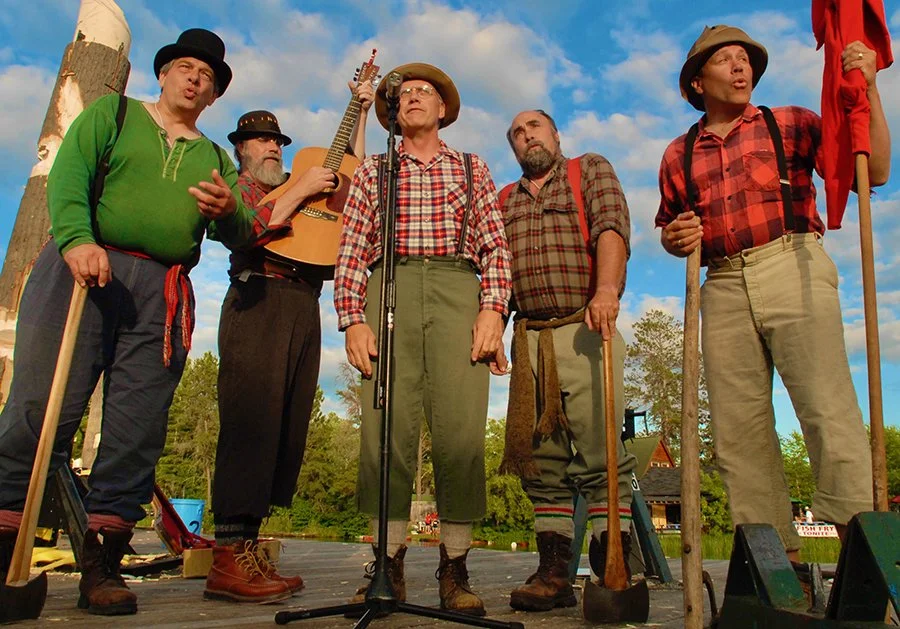
It’s no secret that longtime Park Center board member Hobie Hobart loves being center stage.
His love affair with the spotlight began when he donned a mushroom costume for his fourth-grade operetta, nearly 70 years ago. Thrilled by the attention, Hobie’s been comfortable in front of an audience ever since.
Hobie’s been a key figure in the Park’s transformation from an aging movie theater to today’s lively arts and performance center.
He unclogs toilets, changes light bulbs, and fixes foundation walls in sub-zero weather in his current role as the Park’s Building Committee chair. His wife of 40+ years, graphic designer and artist Kathi Pearson Dunn, created the Park’s signature color scheme of stunning rich plums and greens. Hobie spent a decade as chairman of the Board, guiding the rebuilding after COVID closed the theater, recruiting new ideas, energy, and members to the board.
Effective behind the scenes, it’s Hobie’s alter egos that make him unforgettable.
He’s the grown man dressed in multi-colored tights as the deliciously amusing Chocolate-Covered Cherry Fairy emceeing the “FaLaLa Follies.” His flat-out flatulence as Jimmer in “Escanaba in da Moonlight” stole the show. Who but Hobie could play Bud the Stud in the comedy/farce “Sex Please We’re Sixty?”
Hobie was well established as an entertainer before he came to the Park, but his transition from mushroom to front man followed a wandering path.
The Lake Crystal, Minnesota native, earned a degree in biology from Gustavus Adolphus College and joined a country rock band. He paid bills, however, by partnering with his brother in a hometown painting and building company.
A move to Elgin, Illinois, found him substitute teaching in the science department of the local middle school. There, Hobie became part of “the most amazing thing I’ve ever done in my life” — a 3,300-mile journey from Montreal to the Gulf of Mexico in 20-foot birch bark canoes.
The LaSalle Expedition II was a 1976 bicentennial reenactment of LaSalle’s original expedition in 1681. Sixteen teenage boys and seven adults, including Hobie, spent two years researching the original expedition, learning French, building six 20-foot canoes, and sewing authentic voyageur clothing.
During the course of the journey, rivers froze in historic cold, forcing them to sled canoes and walk 500 miles. A truck accident hospitalized four, but they successfully reached the Gulf of Mexico nine months later, on April 9, 1977.
Hobie used his storytelling skills throughout, in historical presentations in small towns along the route
After another year of teaching, Hobie returned to Lake Crystal and the country rock band. During a gig in northern Minnesota at Quadna Mountain Resort, a chance meeting with a gifted fiddle player and a lumberjack eventually brought him to Hayward.
During a band break, Hobie noticed a young woman with a fiddle and invited her to play a couple of tunes on the band’s next set. Hobie and Molly Otis (then Scheer) have been friends and frequent bandmates ever since.
Scheer’s Lumberjack Show was also part of the resort’s entertainment that day. Noting Hobie’s easy banter in front of a crowd, Fred Scheer invited Hobie to be his show’s emcee.
And so, with a hearty “Yo- ho - ho,” Hobie moved to Hayward.
Along with his emcee work at the lumberjack show, Hobie’s expedition experience made him uniquely suited to become a member of the Les Fils du Voyageur (Sons of the Voyageur), an Ashland-based a cappella singing group that dressed in authentic period garb performing songs of the voyageurs. His Louis Baron the Voyageur persona developed into a popular solo presentation of songs, stories, and dances that toured regionally.
A second group, The Pinery Boys, soon formed, singing traditional logging songs to kick off the Lumberjack World Championships and to stroll the streets at Hayward’s Fall Fest.
His easy style and deep historical understanding of northland history made him a natural choice to emcee the Lumberjack World Championships and Birkie events for decades.

Twenty years ago, Hobie was one of a handful who banded together to keep the 1948 movie theater from being sold or torn down by its out-of-town owner.
“Deanna and Mike (Persson), Paul Mitchell, me, and a few others felt strongly that this building should not be demolished,” said Hobie. “We got a group together and said we’ll buy it. We would do a show or two, and we'd be paying off the guy who wanted to see her gone.”
Eventually, a generous local benefactor paid off the mortgage. But as any homeowner knows, an aging structure needs constant money and attention, and an arts center needs performers and audiences to thrive.
He credits the tireless efforts of the current board, particularly president Carolyn Pare, vice president Chuck Abrams, and programming director Michael Pilhofer, for the Park’s renewed vitality.
"We were so struggling there to get some headway," said Hobie. "That was hard, but now we're going great guns — and moving the right direction."